
About
A multidisciplinary researcher, speaker, and facilitator on the international scene
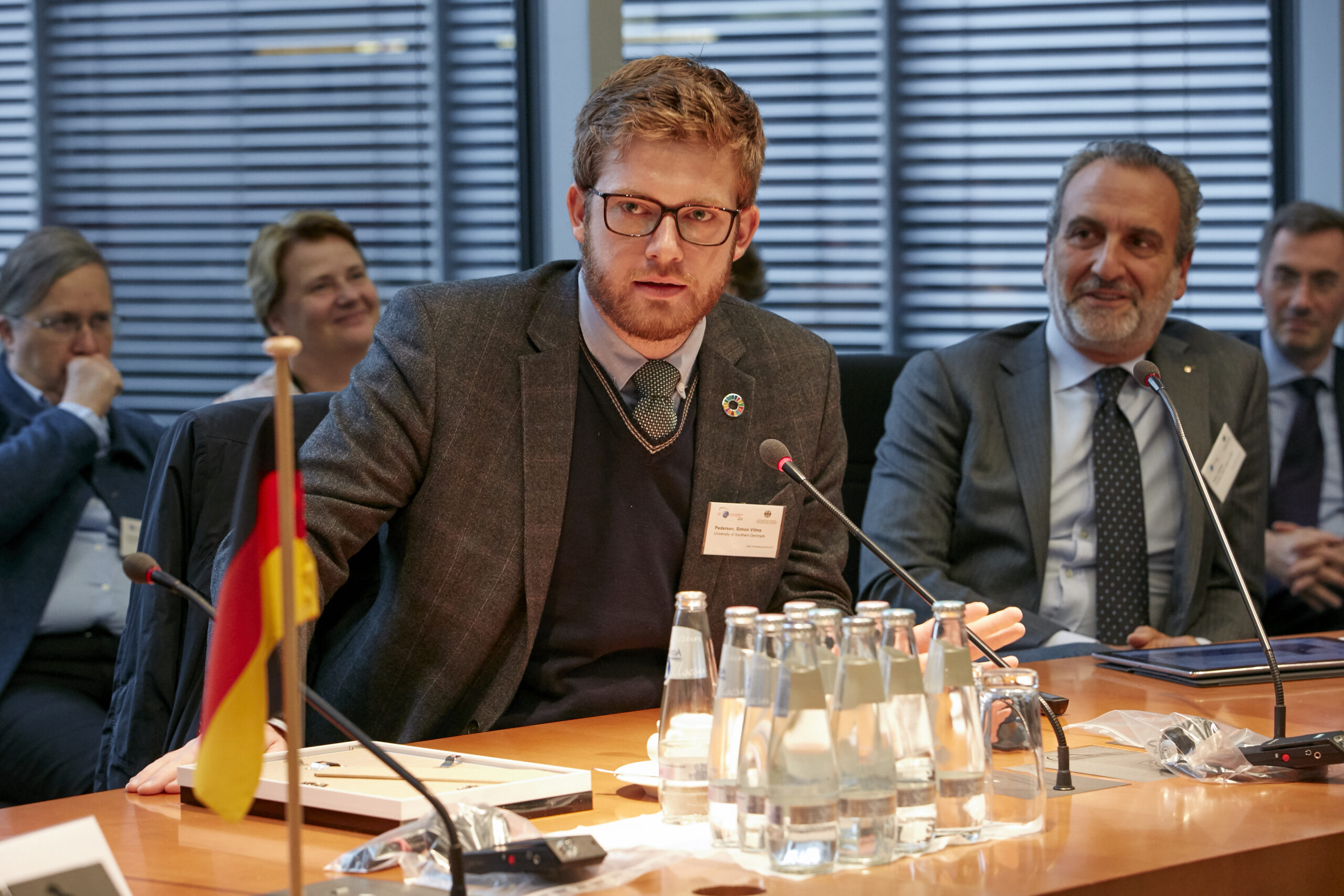
Simon Vilms Pedersen is a recognized researcher holding a PhD in biophotonics and machine learning from the University of Southern Denmark (SDU). Simon is currently a postdoctoral research associate in Professor Molly Stevens’ Group at Imperial College London and YP Council Member of the Danish-UK association, a merger of the Danish Club in London and The Danish-UK Chamber of Commerce. Simon is also a former co-chair of PAUSD and former vice-chair of the Faculty of Engineering’s PhD Committee at SDU while he served alongside as a member of PhD-K, the University-wide PhD-council at SDU.
Simon has been awarded several prestigious awards and fellowships, including the ‘Space for Sustainability’ Award from the European Space Agency and the EliteForsk Travel Fellowship from the Danish Ministry of Higher Education and Science. Simon’s research spans numerous fields, and he masters several scientific disciplines. As a result, he often takes an interdisciplinary approach to research and problem-solving. He has a long-standing passion for sustainability and the green transition. Simon started his academic career measuring ammonia emissions from agriculture, working with atmospheric modelling, and developing temperature models for biogas reactors in developing countries. Currently, his research efforts lie at the interface of AI, optics and diagnostics geared particularly towards engineering new technologies for healthcare.
Simon has had several secondments and lived abroad for many years, particularly in Poland, USA and the UK. He leverages his international background and diverse research experience to build bridges between academia, the public and industry. He is also an active speaker within his fields of expertise, and has addressed audiences ranging from high school students to parliamentarians.
Highlights
Areas of engagement
Active researcher
Simon is currently a postdoctoral research associate in Professor Molly Stevens' group at Imperial College London.
Intriguing speaker
Simon has held numerous talks, with audience from high school students to parliamentarians. He is also a founding member of Adam Montandon's Speakers Impact Network.
Engaging facilitator
Simon is a YP council member of the Danish-UK Association, a merger of the Danish-UK Chamber of Commerce, and actively seeks to bridge academia with industry, from SMEs to large multinational corporations.
Prizes and awards
Simon has been recognized with numerous prizes and awards, among others from the European Space Agency (ESA) and Nordic Energy Research.
Facilitation
Joining the dots is not always easy.
Simon is a facilitator on matters around his areas of expertise. As an active member of the YP council at the Danish-UK Association, he’s on a mission to bridge academia with industry, whether an SME or large multinational corporation. Among other things, he takes part in:
- Bridging between specialists of his areas of expertise
- Supporting scientific dialogue between parties
- Establishing interdisciplinary forums for discussion
- Asking questions to spark new ideas
Backgrounds
Scientific areas of expertise
01.
Agricultural emissions
Some of his earliest work is on measurements of ammonia, an often underestimated pollutant primarily originating from agriculture. He has addressed European parliamentarians on the dangers of ammonia emissions.
02.
Diagnostic technologies
Combining his expertise in bioimaging, optics and AI, a lot of Simon’s current efforts lie in the sphere of diagnostic technologies.
03.
Bioimaging and optics
Having spent countless hours in front of state-of-the-art microscopes, studying plant materials in particular, Simon has seen what can’t be seen by the naked eye.
04.
Artificial Intelligence (AI)
Not only an expert user of AI methods, but Simon has also developed algorithms for sorting through hundreds of thousands of experimental observations.
05.
Programming
Simon started programming in the early 2000s and has since programmed in C++, Java, Python and Objective-C, as well as The Wolfram Language and MATLAB. Simon has even programmed professionally.
06.
Modelling
Whether dispersion modelling for atmospheric emissions or heat- and mass transfer models for bioenergy reactors in developing countries. Simon has modelled it.
07.
Remote sensing
In more recent times, Simon has begun looking to the satellites above to solve problems on Earth. Using his background in agricultural emissions, optics, modelling and programming, Simon is bringing new ideas to the table.
08.
Microfabrication
Having worked in a cleanroom during his time in Professor Tina Jeoh’s group at UC Davis, Simon has hands-on experience manufacturing things impossible to see with the naked eye.
Photo: Frederik Nordhagen